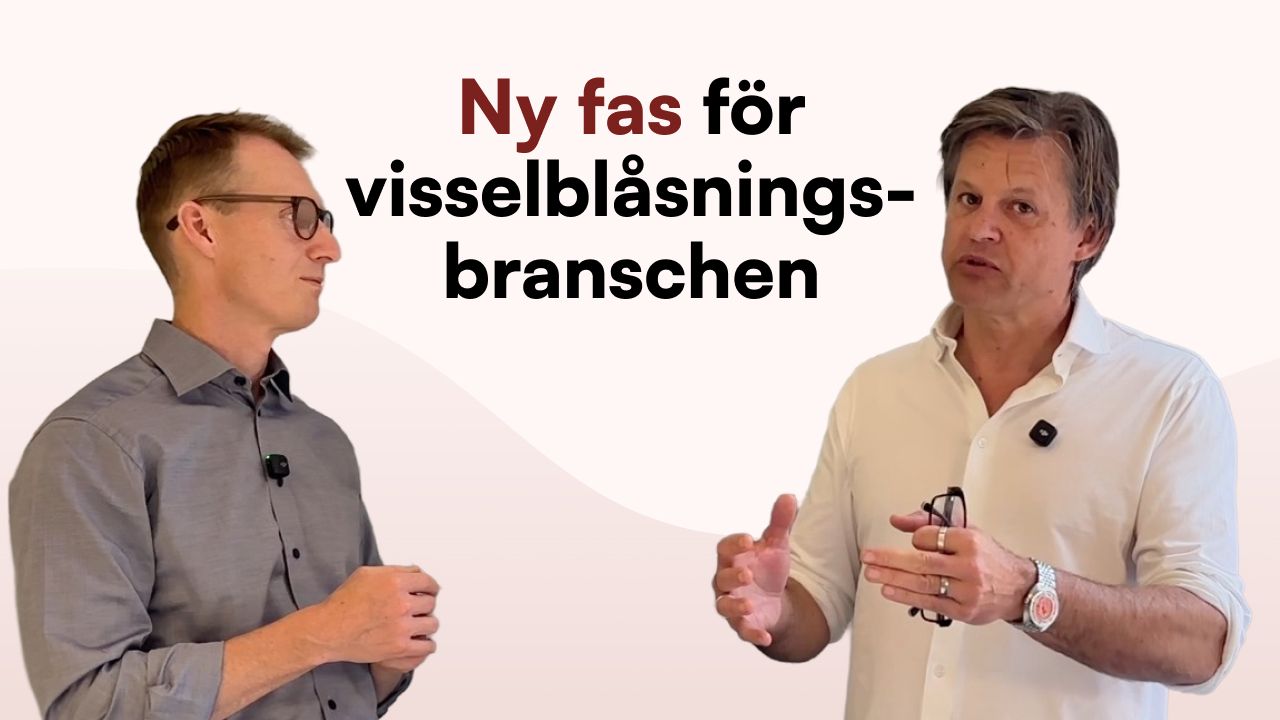
Four Years with the Whistleblowing Act: The Market Matures as Municipal Contracts Are Renewed
Published: June 29, 2026
Approximately four years have now passed since the Swedish Whistleblowing Act entered into force for the country's municipalities. This means that the first generation of procured contracts and system solutions is now expiring, which has triggered an intensive wave of contract renewals and direct procurements.
Looking back at the past four years, it is clear that much has changed. From being a completely new and untested legal requirement, the field has matured significantly. Here, we summarize the three clearest trends and challenges shaping municipal whistleblowing solutions right now.
- Higher Quality and the Decline of Clusters When the legislation was first introduced, uncertainty was high. Many municipalities pooled their resources into large clusters for joint procurements, and several attempted to build their own internal solutions. Today, we see a completely different level of confidence in the market.
Clearer Specifications: Municipalities have gathered valuable experience. They know exactly what they want, and the procurement specifications are of a significantly higher quality. There is a demand for system solutions with specific functionality, such as integrated login (Single Sign-on) and advanced AI support for masking sensitive information when responding to public records requests.
More External Sourcing: Organizations that previously attempted to manage channels entirely internally are now increasingly choosing to seek external assistance, both with the reporting solution and with parts of the case management.
Independent Sourcing Replaces Coordination: The tendency to join large clusters has decreased. Because the process has proven to be smooth and uncomplicated, most municipalities now choose to handle their procurements independently. Furthermore, contracts are being signed for significantly longer periods than before (often up to 6 or 7 years), as the cost structure has stabilized and trust in suppliers has grown.
- Large vs. Small Municipality: Independence in Focus The need for support in the process naturally varies depending on the size of the organization, but interestingly, resources are not the primary deciding factor.
The very large municipalities often have the capacity to handle a large part of the case management internally. For other municipalities, it instead comes down to two critical factors: independence and competence.
In a smaller municipality, where a case officer might only handle a handful of cases per year, the learning curve is steep and the challenges are completely new each time. Additionally, it is operationally difficult to guarantee a completely independent and impartial internal process. Therefore, external parties are increasingly in demand to step in more actively in the workflow, perform initial assessments, and act as a sounding board or investigator in more complex cases.
- The Swedish Work Environment Authority Steps Up Inspections After maintaining a relatively passive profile during the initial years, the Swedish Work Environment Authority (Arbetsmiljöverket), as the supervisory authority, has now sharply increased its audits. They conduct regular inspections to review how channels actually function—and there is a clear common thread in what they look for.
Right now, the authority’s focus is primarily on the written word. They compare the literal text of the law with the organization's internal policy documents and documented routines. They simply assume that what is written in the organization's guidelines reflects their practice. Sooner or later, the authority will knock on the door of most public actors, and when that happens, the documentation must hold up to scrutiny.
How are you preparing? The market has shifted from uncertainty toward standardization and stability. This is highly visible among municipally owned companies—even those with well under 50 employees that are not formally covered by the legal mandate. Many of them still proactively choose to implement external whistleblowing channels, both for the purely business value of capturing useful information and as an important part of their employer branding.
Should you receive an inquiry from the Swedish Work Environment Authority, or are you about to renew your current contracts? As a Lantero client, we are always available to provide direct support. We help you prepare accurate responses for the authority and continuously update our documentation and texts based on current practice and experiences from previous supervisory cases.